Looking for a brownstone or row house in Union City can feel exciting and a little tricky at the same time. You may love the character of an older attached home, but you also want to understand what you are really buying on a block-by-block basis. This overview will help you make sense of Union City’s housing stock, what buyers usually mean by these terms locally, and what to check before you move forward. Let’s dive in.
Union City Housing Basics
Union City is one of the densest cities in the country, with about 53,293.7 people per square mile across just 1.29 square miles of land. According to the city’s 2024 Community Energy Plan, more than 46% of land area is one- to four-family residential, and another 7.5% is multi-family residential. That creates a compact housing landscape where every block can feel a little different.
It is also a city with an older housing stock. The same city plan says more than half of housing units were built before 1960, while about 8 in 10 housing units are rentals. That matters because intact older attached houses are a more limited part of the overall market than many buyers first assume.
The Census Bureau estimates Union City’s owner-occupied housing rate at 19.1%, with a median value of owner-occupied housing at $471,600. That number is a broad citywide benchmark, not a pricing guide for brownstones or row houses specifically. In a market with this much variation in building type and use, you need to evaluate each property in context.
What Brownstone Means in Union City
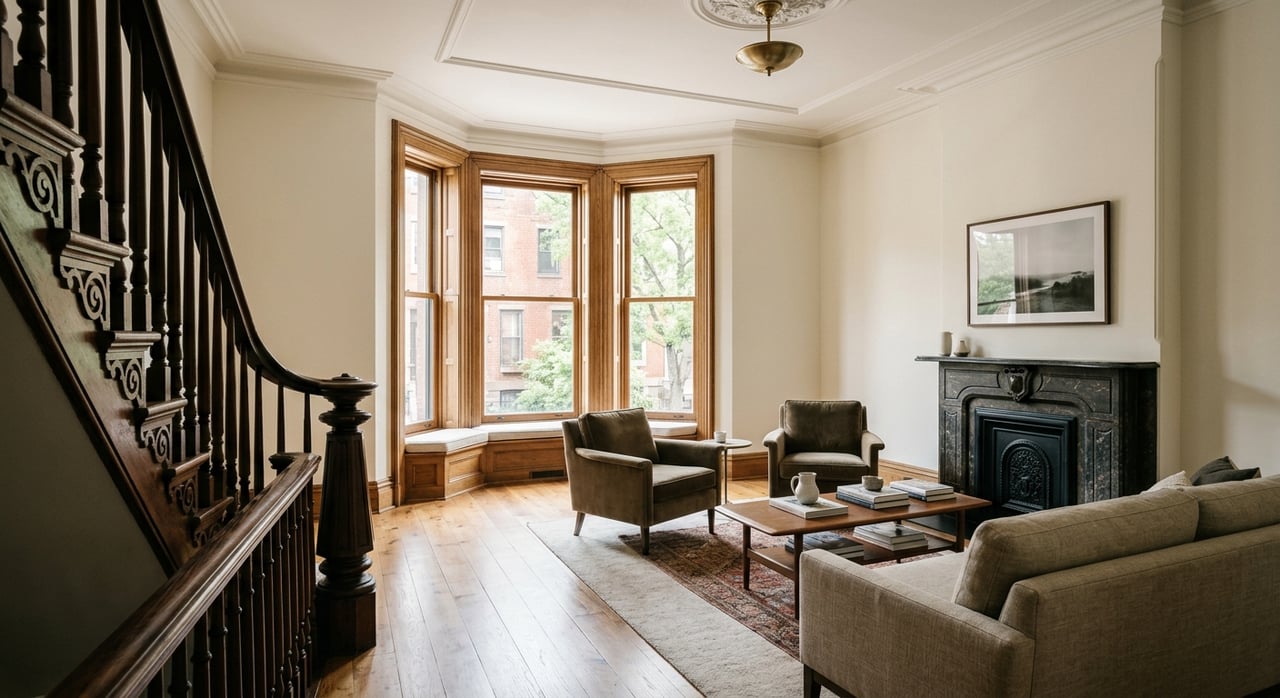
When people picture a classic brownstone, they often imagine a masonry row house with a stoop, a parlor-level entrance, bedrooms above, and kitchen or basement space below. That traditional layout is common in the Northeast and helps explain why these homes remain so appealing to buyers who want character and vertical living.
In Union City, though, the term brownstone is often used more loosely. Buyers may use it to describe attached pre-war masonry homes, brick row houses, or small multi-family properties with older architectural details. In other words, the local definition is often broader than the textbook version.
That flexible use of the term fits Union City’s zoning. The city allows one-, two-, and three-family dwellings in residential districts and also recognizes certain preexisting multifamily development patterns. So when you tour a property that is marketed as a brownstone, it is smart to confirm exactly how the home is configured and legally classified.
Why Buyers Like These Homes
For many buyers, the draw is simple: older attached homes offer a street presence that newer construction often cannot match. Stoops, masonry facades, original proportions, and older architectural details create a sense of character that feels distinct from a typical condo or newer townhome.
These homes can also offer more direct control over the property than a condo. Depending on the home, you may have more freedom to shape the interior layout over time, more separation from neighbors than in a stacked building, and a stronger sense of owning a full piece of the streetscape.
At the same time, this style of ownership is usually more hands-on. With an older attached house, upkeep is part of the package. For the right buyer, that tradeoff is worth it, but it should be part of your decision from the start.
What To Check Before You Buy
Older homes can be wonderful, but due diligence matters even more in this part of the market. Because so much of Union City’s housing predates 1960, buyers should expect to pay attention to the basics of an aging building.
Here are some of the big items to review:
- Mechanical systems
- Masonry condition
- Roof age and condition
- Drainage and water management
- Energy-efficiency improvements
- Legal unit count and use
These are not automatic red flags. They are simply common areas to evaluate when you compare an older attached home with a newer condo or townhome.
If you are considering a property with rental use, lead-based paint rules may also matter. New Jersey requires lead-based paint inspections for rental single-family, two-family, and multiple rental dwellings built before 1978, with inspections every three years or upon tenant turnover, whichever comes first. If a home has an existing or future rental component, that should be part of your review early on.
Historic And Exterior Review Rules
Some Union City properties may fall under local historic preservation oversight. The city’s ordinance requires a certificate of appropriateness before demolition, relocation, exterior alteration or replacement, new construction, or new signs or exterior lighting in designated landmarks or historic districts.
That does not mean every repair becomes a long process. Routine repainting, repair, or exact replacement may be exempt, and interior arrangements are not part of that review. Still, if you are buying with renovation plans in mind, it is important to know whether exterior work could trigger local approval.
This is especially relevant for buyers who want to update windows, alter facades, rebuild stoops, or make visible exterior changes. A house that looks like a straightforward cosmetic project may come with more review steps than you expect. Knowing that before you close can help you budget time and money more accurately.
Hillside Lots Need Extra Attention
Union City’s location on the Palisades adds another layer to some purchases. The city’s Palisades Preservation Overlay District applies along the Palisades from 20th Street to the Jersey City boundary line and is intended to reduce erosion, siltation, flooding, and runoff on steep slopes.
For buyers, that means topography is not just about views. Elevation, grading, drainage, and lot conditions can all affect how you evaluate a property. On certain blocks, a home’s position on the hillside may shape both maintenance needs and future improvement plans.
It is worth noting that the city’s master plan says no Union City population, buildings, or critical facilities are in a floodplain. So flood risk is not the defining issue citywide. On hillside blocks, slope and runoff tend to be the more relevant concerns.
Why Prices Change By Block
In Union City, small distances can have a big impact on value. The city’s main commercial corridors include Bergenline Avenue, Summit Avenue, and New York Avenue, with additional pockets along JFK Boulevard, Broadway, Park Avenue, and Hackensack Plank Road.
That means one block may feel more purely residential, while another has easier access to shops, services, and foot traffic. Neither is automatically better. It depends on what you value most and how the market responds to that location.
The city identifies Bergenline and Summit as active shopping districts, which helps explain why convenience and activity can shape pricing. A buyer who wants quick access to daily errands may see real value there, while another may prefer a quieter block with less activity right outside the door.
Union City’s planning documents also highlight the importance of Manhattan skyline views in eastern sections and design standards that complement architecture from different eras. That suggests outlook, elevation, and overall block character can carry real weight. Two homes with similar square footage may not be priced similarly if one has a stronger view corridor, a more cohesive streetscape, or less nearby redevelopment pressure.
Transit Still Matters A Lot
Transit access is a major part of Union City’s appeal. The city describes broad bus access, commuter vans, and access to Manhattan through the Lincoln Tunnel, bus, and ferry connections. In the 2024 Community Energy Plan, 26.6% of the labor force worked in New York City and 40% of commutes were by public transit.
That helps explain why transit convenience can influence demand even away from the waterfront. Buyers are often not just shopping for square footage. They are also buying into a daily routine, and commute ease remains part of that equation.
For an older attached home, proximity to transportation can help offset tradeoffs like smaller outdoor space, older systems, or a busier surrounding block. When you compare properties, commute reality should be part of the same conversation as architecture and price.
Brownstones Versus Condos And Newer Townhomes
If you are deciding between an older row house and a newer property type, the choice often comes down to lifestyle as much as budget. Older attached homes usually offer more architectural character, stronger historic feel, and more individual control over the property.
Newer condos and townhomes may offer a simpler ownership experience. Depending on the building, they can reduce some maintenance responsibilities and provide a more modern systems package from day one.
The tradeoff is that newer properties rarely offer the same pre-war street wall, stoop presence, or historic fabric that many Union City buyers are seeking. If character is high on your list, an older attached home may feel more special. If simplicity is your top priority, a condo or newer townhome may be the better fit.
A Smart Buyer’s Shortlist
Before making an offer on a Union City brownstone or row house, try to confirm these points first:
- Whether the property is legally one-, two-, or three-family
- Whether there is any rental use that triggers lead-based paint rules
- Whether the home is located in a historic district or designated landmark area
- Whether the lot falls within the Palisades Preservation Overlay District
- Whether planned exterior work could require local review
- How the block balances residential feel, commercial access, views, and redevelopment activity
This kind of checklist can help you compare homes more clearly. It also helps you avoid treating all attached homes as if they belong to the same category, when in practice they can differ quite a bit.
If you are weighing character, condition, and long-term value in Union City, local context matters. A thoughtful review of the home itself is only part of the picture. The block, the slope, the legal use, and the city rules around future changes can all shape whether a property is the right fit for you.
For buyers who appreciate older homes, this can be a very rewarding corner of the Hudson County market. The key is knowing how to separate charm from assumptions and how to evaluate each property on its own terms. If you want a steady, informed perspective as you compare historic homes, row houses, condos, and multifamily opportunities across Hudson County, Leda Duif is here to help.
FAQs
What counts as a brownstone in Union City?
- In Union City, buyers often use the term brownstone broadly to describe attached pre-war masonry homes, brick row houses, and some small multi-family properties, not just classic single-family stoop homes.
Are Union City row houses usually single-family homes?
- Not always. Union City zoning allows one-, two-, and three-family dwellings, so it is important to verify the legal unit count before you buy.
Do older Union City homes usually need more maintenance?
- Often, yes. Because much of the city’s housing was built before 1960, buyers should pay close attention to systems, masonry, roofing, drainage, and possible energy-efficiency updates.
Do Union City historic rules affect home renovations?
- They can. In designated landmarks or historic districts, certain exterior changes may require a certificate of appropriateness, while interior arrangement is not part of that local review.
Are hillside homes in Union City riskier to buy?
- Not necessarily, but hillside lots can require closer review of slope, runoff, erosion, and drainage, especially within the Palisades Preservation Overlay District.
Why do Union City home prices vary so much by block?
- Block-level differences can reflect proximity to commercial corridors, transit access, views, redevelopment pressure, and overall street character, all of which can influence buyer demand.