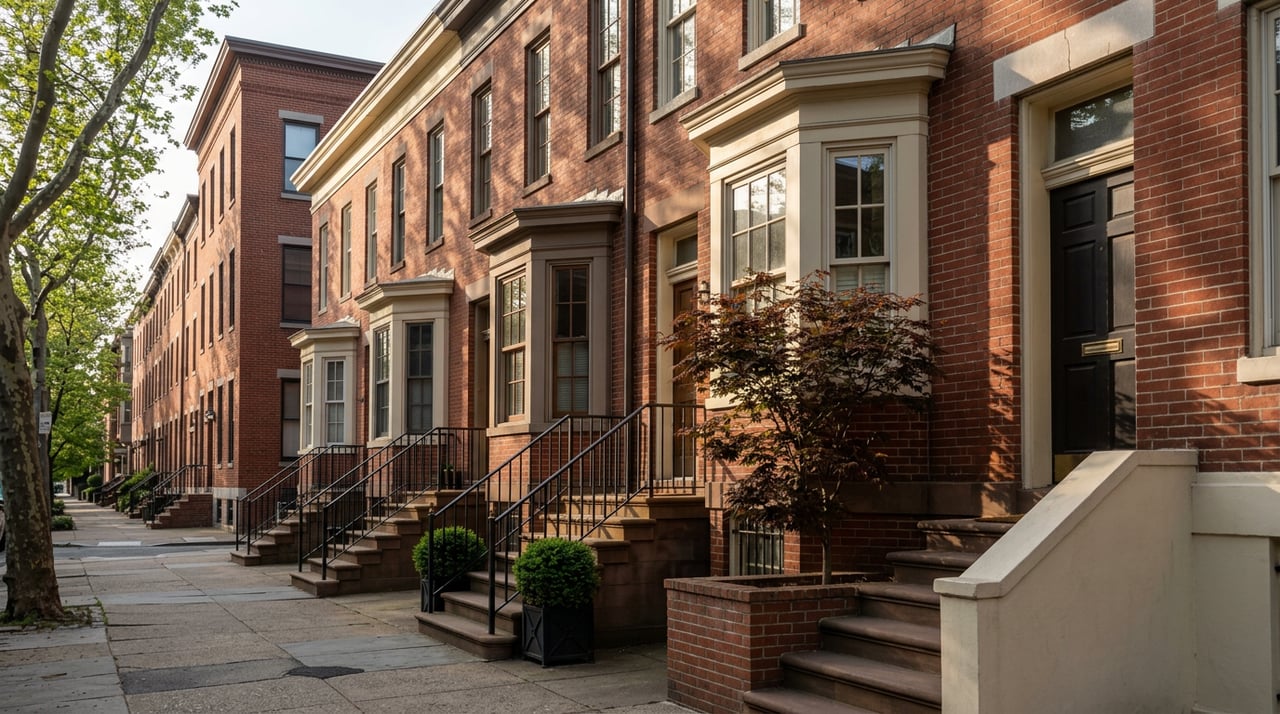
On a Saturday afternoon, Bergen Avenue between Duncan Avenue and Reed Street closes to cars. Folding chairs spill off the sidewalk. Someone's ordering a po' boy from Krewe of McGinley Square. Someone else is three tables down with a smashburger from Wing Bar. A few blocks north, past the McGinley Square Pub, sits a parking lot that Saint Peter's University students still cross on foot every morning, the same surface lot that was supposed to become a 21-story tower with a movie theater a decade ago.
The approved tower and the neighborhood businesses that opened nearby are both part of McGinley Square's story today.
The Proposed Tower Site
In March 2016, Jersey City approved Saint Peter's University's plan for a 21-story mixed-use tower at 688-700 Montgomery Street, complete with three levels of retail and entertainment space, a movie theater, and a 300-car parking garage. It was supposed to be the anchor of a neighborhood that had been formally designated "in need of redevelopment" back in 2011, a designation serious enough that the U.S. Department of Housing and Urban Development gave the area a $250,000 Choice Neighborhoods grant just to study how to turn it into a functioning mixed-use district.
As recently as 2024, engineering documents for the project still described the property as "a surface parking lot, currently utilized by Saint Peter's University," the same description that applied when the plan was first approved eight years earlier. In 2019, the university also filed a separate, smaller application with the Jersey City Zoning Board for a six-story, 151-bed student dormitory at 762 Montgomery Street, directly across from the McGinley Square Pub. That was a scaled-down version of the same ambition, and it too has not visibly changed the block.
None of this is a knock on the university or the planning process. Big institutional projects move on institutional timelines, and that's simply the reality of financing and building something 21 stories tall in a dense urban neighborhood. But the neighborhood's story is also visible in its local businesses and public spaces.
New Restaurants on Bergen Avenue
The neighborhood's real turnover has happened storefront by storefront, mostly run by people who already lived here.
Krewe of McGinley Square opened at 673 Bergen Avenue in the spring of 2021. It's the project of Jersey City residents Hank Morris, an actress and filmmaker, and her husband, chef Anthony Tamburro, and it brought New Orleans cooking to Bergen Avenue: étouffée, po' boys, jambalaya, and a rotating vegan menu alongside the Cajun standards. It's become enough of a fixture that it now anchors part of the SID's weekend outdoor programming.
Two years later, in the fall of 2023, Wing Bar took over the former Taco Bar space at 684 Bergen Avenue. It was opened by Morgan Kulessa and Bryan Lewis, both Jersey City residents who met as students at Seton Hall University and had already spent years working with and consulting for restaurants in the immediate area before opening their own. The menu stays deliberately narrow: wings, tenders, a smashburger, waffle fries. The bar runs Tuesday trivia and Thursday karaoke, and it's become the kind of spot regulars from Edgewater and Hoboken will make a trip for on a Friday night.
Both openings happened inside the same stretch of Bergen Avenue that the city's 2011 redevelopment plan had specifically targeted for revitalization.
Longstanding McGinley Square Businesses
McGinley Square's food and retail scene isn't only new arrivals. Some of its most reliable spots have been here since before "redevelopment" was even a word attached to this neighborhood.
- Chicken Delight, serving fried chicken, ribs, and pizza since 1965, has been open for close to sixty years, decades before the 2011 redevelopment designation.
- Lee Sims Chocolates is now run by the fourth generation of the same family, still working out of the same McGinley Square storefront where the business started.
- Imago Beauty Group, an Aveda-affiliated salon, has operated in the neighborhood since 1997, the same year the McGinley Square Partnership itself was created by city ordinance.
These longstanding businesses are part of what gives the neighborhood a sense of continuity.
The Plaza in a New Form
There's one more layer to this that's worth knowing if you live here: the pedestrian plaza on Bergen Avenue wasn't part of the official plan either, not exactly.
Back in 2011, the city's redevelopment proposal called for a permanent pedestrian mall running from Jordan Avenue to Tuers Avenue, part of a broader vision to expand and rebuild McGinley Square's public plaza as the neighborhood's civic centerpiece. The permanent mall was not built. A smaller, recurring pop-up plaza is run by the McGinley Square Partnership, the same Special Improvement District that's been assessing local businesses since 1997 to fund cleaning, lighting, and promotion along Bergen Avenue.
The pop-up plaza closes Bergen Avenue between Duncan Avenue and Reed Street to vehicle traffic on weekends, turning it over to outdoor dining from spots like Astor Bar and Grill and ITA Italian Kitchen, plus live music and community programming. It's a smaller, recurring version of the pedestrian-mall idea in the 2011 plan. McGinley Square also shows up on the calendar for JC Fridays, the citywide quarterly arts festival now marking its 20th year, which brings visual art, live music, and open studios to storefronts across the neighborhood several times a year.
What This Actually Tells You
If you live in McGinley Square, its character is visible in its local businesses and programming: two restaurateurs who spent years learning the local restaurant scene before opening their own place, the business district's outdoor plaza, and a chocolate shop that's been run by the same family since before most of the newer condo buildings existed.
Their everyday presence offers a useful counterpoint to what remains only approved on paper.
If you're weighing what a neighborhood like this is actually worth, both in daily life and down the road, that distinction between what's approved and what's already real is exactly the kind of thing worth talking through with someone who watches these blocks closely. Dwellings with Leda & Co works across Jersey City and Hudson County with exactly that kind of block-by-block read. Let's Connect.